Gyms
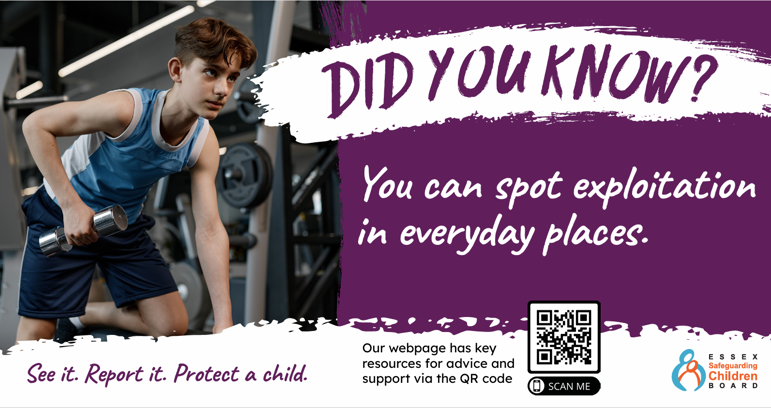

Safeguarding in Gyms
Strengthening safeguarding in fitness and training environments
Gyms and fitness centres play a positive role in supporting health, wellbeing and community connection for children and young people. They are not assumed to be unsafe environments.
However, gyms are also everyday community spaces where young people may spend time independently, particularly in larger or 24‑hour facilities. For this reason, safeguarding awareness is an important part of keeping young people safe.
In Essex, safeguarding in gyms sits within the Risk in the Community (RIC) approach, which recognises that exploitation can occur outside the home, in public and community settings, and that prevention depends on strong partnership working.
Why a focus on gyms is important
National safeguarding partners, including the NWG Network, have highlighted a growing trend across England where gyms and fitness facilities have been misused by individuals involved in criminal activity, including the holding of illicit items in lockers and drug‑related activity linked to these venues.
This has been reported by multiple local authorities and safeguarding partnerships. The concern is not about gyms themselves, but about how certain features of fitness environments can be misused when safeguarding arrangements are not strong.
These features can include:
- Large, busy environments
- Periods of reduced supervision
- Shared or unsupervised locker facilities
- Young people attending independently
This national picture reinforces the importance of early awareness, prevention and deterrence, rather than suggesting that exploitation is happening in every gym.
Our work with gyms in Essex
As part of the Risk in the Community approach, partners in Essex work directly with gyms and leisure providers to:
- Raise awareness of exploitation risks
- Support staff confidence in spotting concerns
- Encourage clear safeguarding processes and reporting routes
- Share examples of effective practice
These visits are supportive and preventative. They are not inspections and do not assume wrongdoing. The focus is on helping providers strengthen their safeguarding arrangements and reduce opportunities for harm.
How strong safeguarding helps
Strengthening safeguarding in gyms helps to:
- Deter misuse of facilities
- Protect young people using the venue
- Support staff to act with confidence
- Reduce risk to the business, staff and members
“Good safeguarding practice is about awareness, environment and action”
What gyms can do
Gyms can strengthen safeguarding by:
- Ensuring staff know what to look out for
- Having clear internal reporting processes
- Knowing how and when to share concerns
- Creating environments where misuse is less likely
- Working openly with safeguarding partners
Gyms are not expected to investigate concerns or prove criminal activity. Their role is to notice concerns and share information so safeguarding partners can respond appropriately.
Working together to prevent harm
By working together with gyms and fitness providers, Essex partners aim to:
- Reduce opportunities for exploitation
- Strengthen community safety
- Protect children and young people
- Support safer environments for everyone
We have created a set of resources to support gyms to strengthen their safeguarding responses at their venues.
Key Resources:
Safeguarding Checklist for Gyms;
Further support, guidance, training and development for the sport sector can be found at Active Essex; Delivering Sport | Active Essex